

Walk down the men's grooming aisle and nearly every "face cream" is the same thing in a different bottle: water, oil, and fragrance. We went through the dermatology research on how men's skin actually ages — and where most of these products quietly fall short. Here's what stood out.
Men's skin is roughly 25% thicker than women's — yet most creams aren't built for it
Male skin has a thicker dermis, denser collagen, more active oil glands, and larger pores. That's not a marketing line — it's measurable in the research. The catch: the vast majority of "face creams" are formulated around thinner, drier skin, then relabeled for men with a darker bottle and a cedarwood scent. A formula tuned for the wrong skin type doesn't absorb or deliver its actives the same way.
Men lose collagen on a steeper curve — and it starts in your 20s
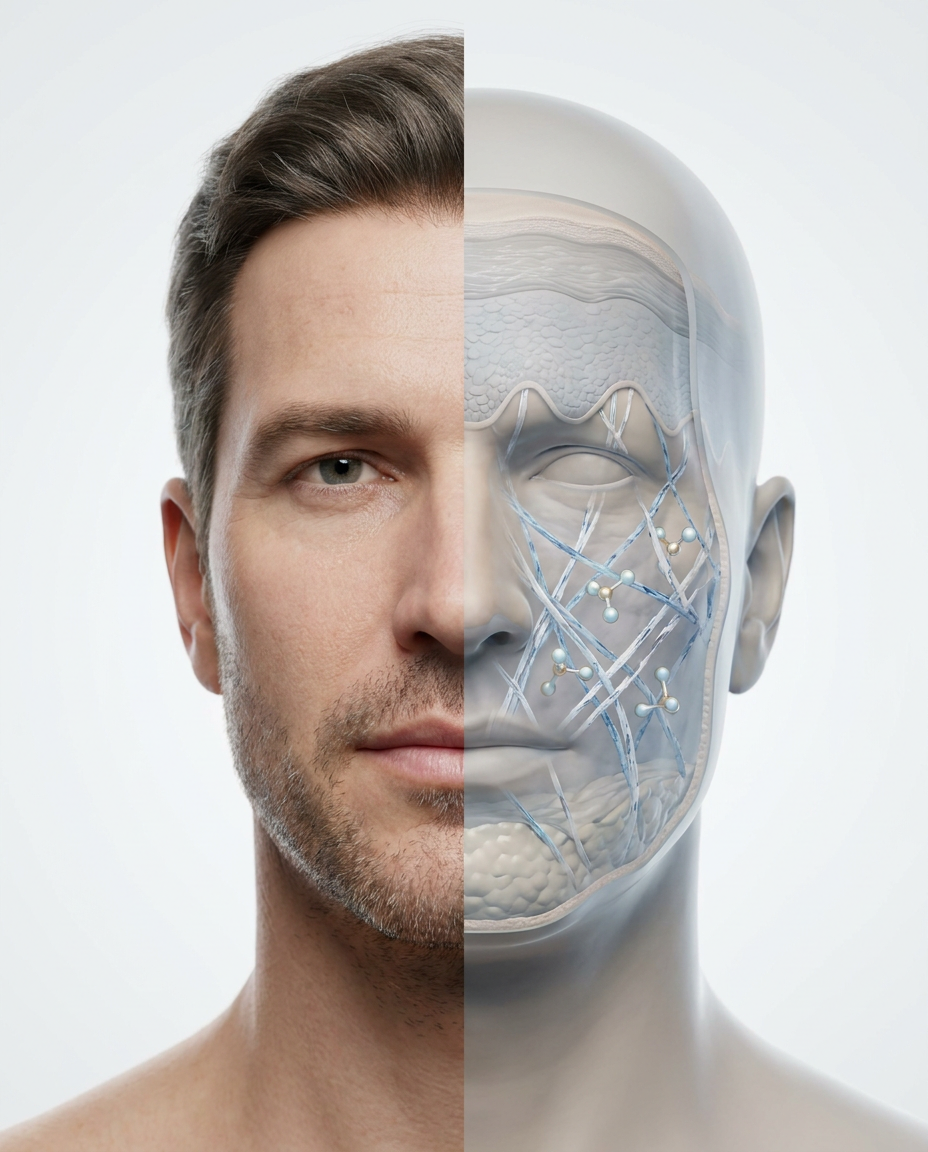
Collagen density falls about 1% per year in adulthood — the decline just stays hidden longer in men.
Because men start with denser collagen, aging often looks invisible for years, then seems to arrive all at once as deeper lines and slack skin. Research puts adult collagen loss at roughly 1% per year. The ingredients shown to support the skin's natural collagen can't be found in a basic moisturizer. They're advanced peptides like acetyl hexapeptide-8, which help promote firmer, younger-looking skin rather than just sitting on top of it.
Most face creams for men are just fragranced moisturizers, with no anti-aging properties
Under-eye bags are mostly fluid and blood pooling — not something you can sleep off
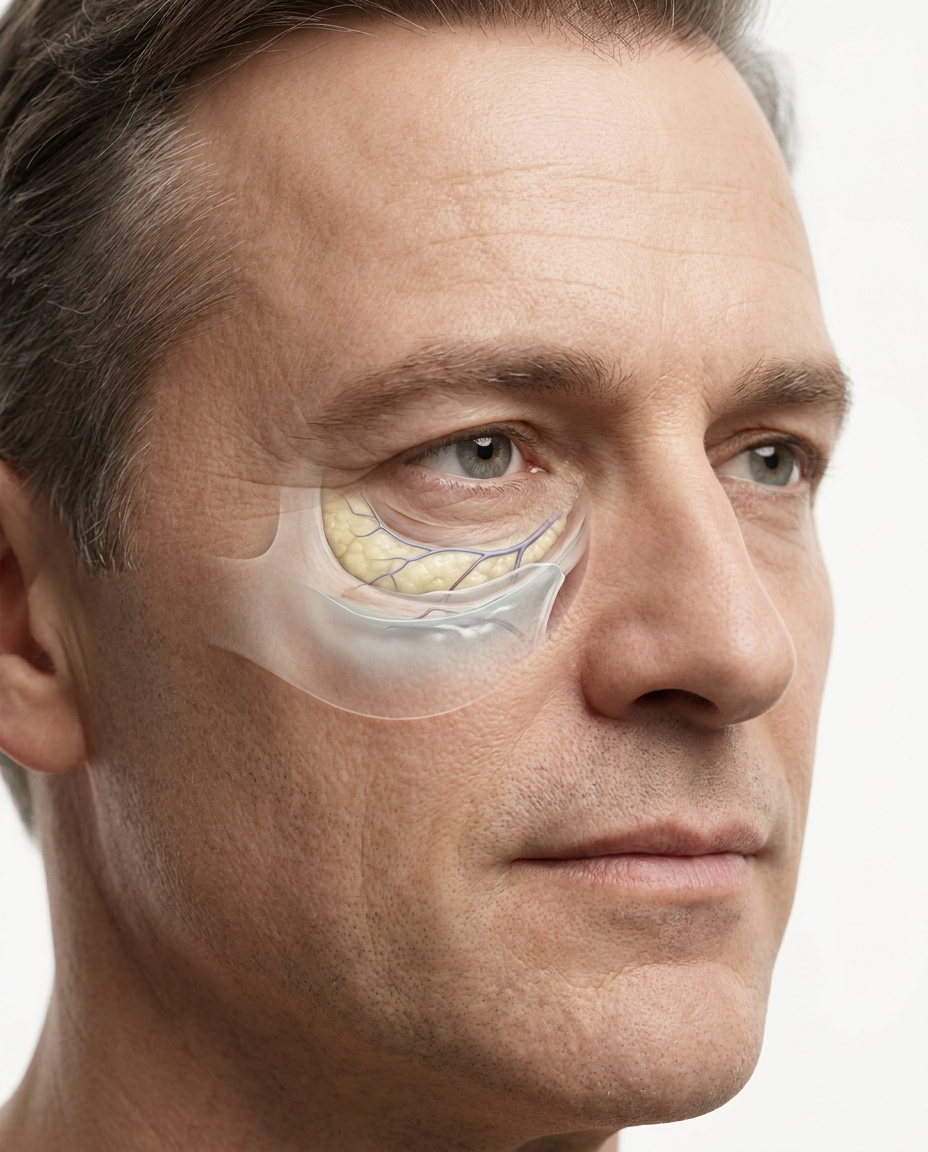
The under-eye area is the thinnest skin on the body — puffiness there is vascular, not just fatigue.
The skin around the eyes is the thinnest on the body, so fluid retention and pooled blood show through as puffiness and dark circles. More sleep helps at the margins, but the mechanism is vascular. Topical caffeine is well documented to constrict those vessels and de-puff the area — which is why it belongs in a cream applied there, not in another cup of coffee.
Daily shaving quietly wears down the skin barrier — and a plain moisturizer doesn't rebuild it
Dragging a blade across skin every morning strips protective lipids and spikes water loss through the skin barrier. That's why post-shave skin feels tight, then rough. Rebuilding it takes specific barrier-repair actives — niacinamide, allantoin, urea, and squalane — not just a film of oil. Most men's creams soothe the sting for an hour and do nothing for the barrier underneath.
Men's dark spots are usually accumulated sun damage — and men use far less sun protection
Decades of skipped sunscreen show up as uneven tone and stubborn dark spots. The actives with the strongest evidence for fading them and evening out tone are niacinamide, vitamin E, and gentle exfoliating acids like lactic acid — worked in daily, over weeks. A basic moisturizer has none of these actives.
The routine you'll actually stick with beats the "perfect" 6-step one you'll quit
In dermatology, adherence is one of the strongest predictors of whether skincare works at all. Men, on average, abandon multi-step routines fast. That's the real case for a single multi-active cream: it collapses the eye cream, the anti-wrinkle serum, the dark-spot corrector, and the moisturizer into one step you'll actually do every morning — the only version of a routine that produces results.
Particle Anti-Aging Face Cream for Men
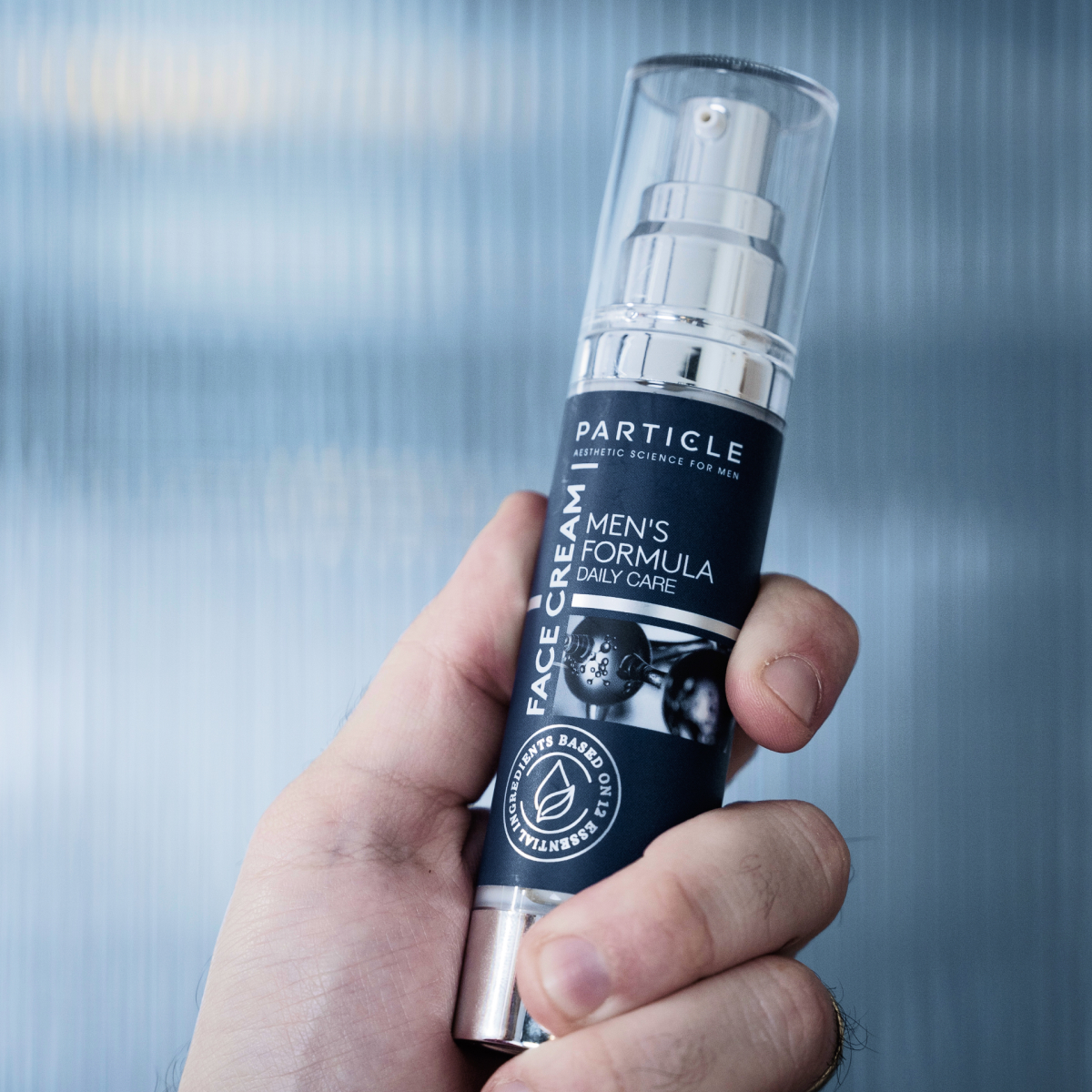
Target eye bags, dark spots, and wrinkles with one cream. Particle's 6-in-1 formula combines 12 active ingredients—including peptides, caffeine, niacinamide, and hyaluronic acid—to help you look more refreshed every day.
Get 20% Off & Free Shipping| Feature | Particle Face Cream | Typical men's moisturizer |
|---|---|---|
| Active ingredients | 12 | 0–2 |
| Collagen-supporting peptides | Yes | No |
| Targets eye bags (caffeine) | Yes | No |
| Fades dark spots & evens tone | Yes | No |
| Barrier repair (niacinamide, allantoin) | Yes | No |
| Engineered for men's skin | Yes | Generic base |
| Money-back guarantee | 30 days | Varies |
Quick questions
I already use a moisturizer — isn't that enough?
Moisturizing and anti-aging are two different jobs. A moisturizer hydrates the surface; it has no effect on collagen, eye bags, or dark spots. Those need specific actives — peptides, caffeine, niacinamide — that a basic moisturizer simply doesn't contain.
Do men actually need an anti-aging cream, or is that marketing?
Male skin loses collagen on a measurable curve and takes on more cumulative sun damage because men use less sun protection. That means men can benefit from anti-aging actives just as much as women. But because men's skin is thicker and has unique characteristics, the most effective formulations are those designed specifically for men.
$69 seems like a lot for one cream.
It replaces a lineup — eye cream, anti-wrinkle serum, dark-spot corrector, and moisturizer — which typically runs $200–300 together. Bought as a single product, the price drops to $55-$69 a unit, and the 30-day guarantee means the first bottle is effectively risk-free to test.